This final stage of the model is where learners are more independent in their learning and demonstrate greater critical thinking and self-reflection. Relating this to the distance learning module I have been running that is now reaching its conclusion, while it may be true that some of the students have reached this stage, it is fair to say that this is probably not typical. And I think it is understandable and reasonable to not expect this to be the case. This is a single module over 14 weeks. The module itself, while offered as a stand-alone course, is designed to be a introductory course/module that forms part of a bigger whole.
As and when we have the MAPP-DL running, we might expect students in the second semester modules to be reaching this stage (or reaching it more quickly) as they are already comfortable with the learning technologies, they are continuing to work with a student cohort they have socialised and exchanged with (if appropriately supported) and they are building their knowledge further.
Showing posts with label Five stage model. Show all posts
Showing posts with label Five stage model. Show all posts
Wednesday, 4 February 2015

Wednesday, 14 January 2015
Knowledge construction : Stage four of the five stage model
At this stage, learners are more confident, more active in their learning and interaction, and require less and less technical support. They are therefore more actively involved in knowledge construction than at earlier stages and may be more involved in creating opportunities to explore and challenge the topics they are encountering on the course.
It seems to me that the boundaries between stage 3 and 4 are quite blurred, and maybe that is intentional and understandale. I suspect the boundaries between all stages are to be somewhat fuzzy.
In terms of the Intro to Positive Psychology distance learning module I have been running, this aspect seems to have developed quite naturally. On reflection, I think my support has paralleled that which the 5 stage model suggests an e-moderator might do at these stages to support learners as they progress. There is more I could have done, such as more active encouragement of co-coaching between students, though I am feeling reassured that my actions seem to have been in line with this model of good practice!
Wednesday, 10 December 2014
Information exchange: Stage three of the five stage model
If learners have successfully passed through stages 1 and 2, then at stage 3 they are building on these and beginning to share more information, interacting with each other, and developing strategies to engage with the course content.
On the Intro to Pos Psych distance learning module this has been happening. Students are engaging well with the discussion boards, and have been spontaneously building discussions, responding to each other. Some of these I have tried to stimulate and play a part in to encourage others to post comments. In retrospect, and now being more familiar with this model of e-learning and the thinking behind e-tivities, I could have been even more mindful of this. That is, rather than encouraging or inviting students to post thoughts to the discussion board, I could have made this a 'required' e-tivity, by having students post at least one comment for each discussion thread and commenting on at least one other's post. I might have also asked a different student each week to be a 'facilitator' for the discussion that week and have them take responsibility for beginning the discussion.
UPDATE (2 Feb 2015): I related these ideas to one of the summative assignments for the Intro to Pos Psych distance learning course. This is a poster presentation that students submit via turnitin for assessement. In the attendance version of this module, students give either an oral presentation or a poster presentation to the group as part of the final teaching weekend. They are then encouraged to look at other students' posters and to ask questions to the person whose poster it is. The idea is that this feels like a poster session that you would get at an academic conference, and it gives the students some experience of disseminating and discussing their work in this way.
To replicate this online, I asked students to post their posters on the discussion board and then to look at others' posters and to post questions for at least 2 other students. This built some good in-depth discussion between students that needed little input from me (I did make sure I asked at least one question to each student). The depth of the discussion was in some ways greater than the discussions that we sometimes see at the attendance weekends. Added to this, we have the record of the discussions automatically archived in the discussion board, which may be useful for the external examiner. Result! [I will attempt to copy this discussion across to my PGCert Bb organisation, but if this i snot possible I will aim to add the PGCert T-eL Course Team to the PS726 module shell.]
Thursday, 20 November 2014
Online socialisation: Stage two of the five stage model
Stage two is when students are beginning to engage with the materials, the tutor (or are we to refer to the tutor as the e-moderator?), and with other students.
One of my first attempts to begin bringing students 'into' the course on the Intro to Positive Psychology distance learning module has been to direct students to the discussion forum on Bb and write a post to 'say hello!' to show they made it there, knew how to post a comment, and to say a little about themselves and what brought them to this course. I feel now this was a little one-dimensional and could have been just one of some more in-depth attempts to begin interactivity between students. The attendance version of this module has students introduce themselves to the group and this can be quite an uplifting exercise as students begin to quickly share information about themselves. This is harder to support and encourage online when students feel more distant (literally and figuratively) from each other.
However, mindful of Salmon's (2000) five stage model, I will consider ways in which I can give greater emphasis to this important element of online socialisation for students. For example, I can encourage students to say more about their background, their interest in positive psychology, what has brought them to the course, and what they hope to gain from the course. The next time this module runs it will likely form part of a fully 'distance' MAPP and so the module will be part of a longer programme. That said, there will still be some students who are on the module as a stand-alone short course.
Reference
Salmon, G. (2000). E-moderating: the key to teaching and learning online. London: Kogan Page.
Wednesday, 12 November 2014
Access and motivation: Stage one of the five stage model
 Salmon (2000) outlined a five stage model for e-learning that has become an established model
around which online courses are developed. This model is a central theme throughout the Certificate Stage of the MSc t-eL. The intention is that this will be the first of five blog posts to relate to each of the five stages of Salmon's model.
Stage one relates to access and motivation, and emphasises that learners at this early stage will be focused on the practical tasks of accessing materials, getting online, negotiating usernames and passwords, and so on. At this early stage they are likely to be motivated though this motivation may be fragile if technology, course structure, and tutor support do not make then entry to the course as welcoming, easy, and stress-free as possible!
The distance learning module I am running this semester is now 4-5 weeks in, and this is probably something I may have taken somewhat for granted! I did try to consider the likely issues facing learners such as usernames, IT induction, access to Blackboard, and so on. I realise now this is especially important and something I want to pay even more attention to the next time we run the module (by which time it may be part of a fully distance MAPP programme!).
Reference
Salmon, G. (2000). E-moderating: the key to teaching and learning online. London: Kogan Page.
Wednesday, 22 October 2014
CO710: (week 3 notes) Developing an approach to t-eL - Access andMotivation
Focusing on Salmon's (2000) model (developed in 2006?)
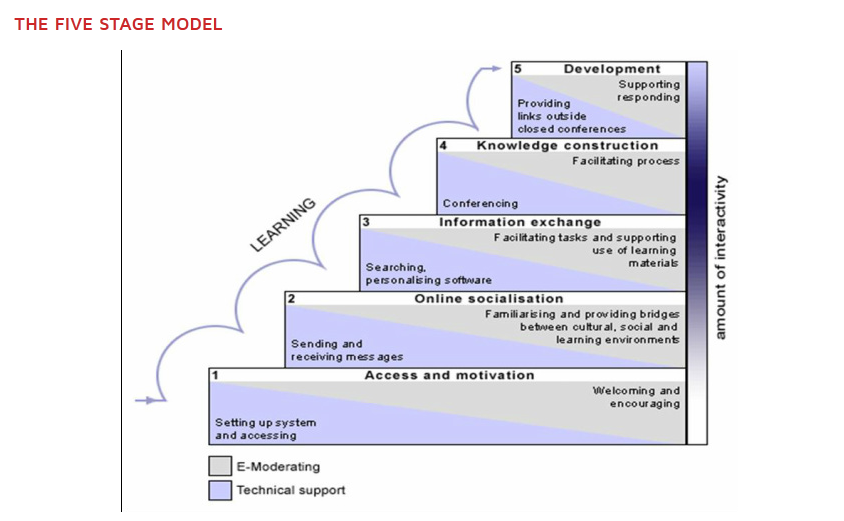
The five stage model... First stage is access and motivation.
5 stage model. V important in assisting us as we develop our e-learning programmes and supporting students. Acts as a scaffolding. Helps students to stand on their own. Online learning must be a pleasurable and successful experience with participants supported throughout.
Is it circular?
Focus on access and motivation.
Dealing with frustration
Issues to do with faith in technology - There is no such things as fail-safe
Relationship between access ability and motivation to be online is complex
Salmon: emotional and social capacity to learn with others online.
Discussion also about netiquette... need to consider this for Intro to Pos Psych
Discussion also about netiquette... need to consider this for Intro to Pos Psych
Subscribe to:
Posts (Atom)